

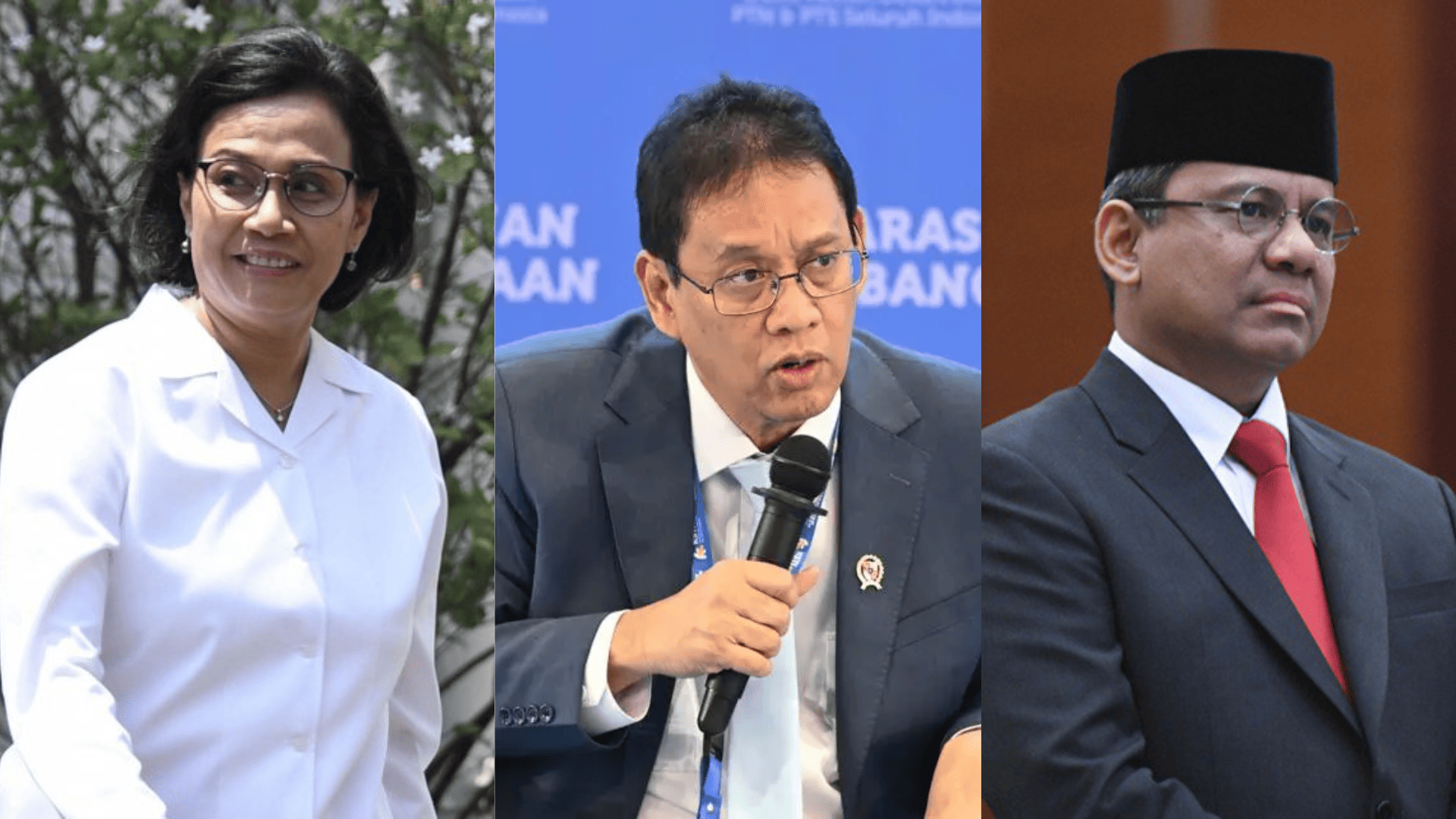
Since President Prabowo Subianto took office in October 2024, Indonesia’s Ministry of Finance has been led by three different figures. Sri Mulyani Indrawati began her tenure under the Red and White Cabinet, before being replaced by Purbaya Yudhi Sadewa in September 2025. One year later, on September 14, 2026, Suahasil Nazara was inaugurated as Minister of Finance, succeeding Purbaya. The three ministers come from different backgrounds and bring different approaches to managing the country’s public finances. So, what has been the main focus of each of them?
Sri Mulyani: Maintaining Efficiency and Fiscal Sustainability
Sri Mulyani is an economist and technocrat who has long been one of the key figures in Indonesia’s fiscal policy. She was once again entrusted with leading the Ministry of Finance at the beginning of the Prabowo administration, having previously served as Minister of Finance since 2016.
During the early period of the Prabowo administration, one of Sri Mulyani’s main concerns was maintaining fiscal sustainability while meeting the funding needs of the government’s various priority programs. Budget efficiency became an important part of this approach, with an emphasis on making government spending more productive and ensuring that it delivered greater benefits to society.
Purbaya: Promoting Growth through Liquidity
In September 2025, Purbaya Yudhi Sadewa took over as Minister of Finance. Prior to this appointment, he served as Chairman of the Board of Commissioners of the Indonesia Deposit Insurance Corporation (LPS). Purbaya placed greater emphasis on accelerating economic growth. One of the policies that attracted considerable attention was the government’s placement of Rp200 trillion in state funds with state-owned banks (Himbara) to increase liquidity and encourage greater lending. The logic was straightforward: as banking liquidity increases and credit becomes more readily available, consumption, investment, and business activity are expected to gain momentum.
Suahasil: Maintaining the Credibility of the State Budget
On September 14, 2026, Suahasil Nazara was inaugurated as Minister of Finance. He is no newcomer to fiscal policy. Previously, Suahasil served as Deputy Minister of Finance from 2019 and had also led the Fiscal Policy Agency (BKF). He is also an academic and Professor of Economics at Universitas Indonesia. In his initial statements, Suahasil emphasized the importance of maintaining the health and credibility of the state budget (APBN), while ensuring that fiscal policy continues to support economic growth and the government’s priority programs.

Three Ministers, Three Emphases
The transition between these three ministers illustrates how fiscal policy must constantly balance multiple objectives. Sri Mulyani emphasized efficiency and fiscal sustainability, Purbaya focused on promoting growth through stimulus and liquidity, while Suahasil has placed the credibility of the state budget among his key concerns while continuing to support economic growth.
This transition is interesting not only because of who serves as Minister of Finance, but also because it highlights a fundamental question in economics: how can limited public resources be allocated to achieve growth, stability, and welfare at the same time?
Ultimately, fiscal policy is not simply about how much money the government spends. It is also about what that money is spent on, who benefits from it, how it is financed, and whether the policy can be sustained over the long term.